Showing posts with label 70 cm. Show all posts
Showing posts with label 70 cm. Show all posts
Thursday, July 27, 2017
SOTA Alert: Mt. Tamalpais, W6/CC-063
I have tentatively planned for Saturday, 29 July 2017 to be my first activation using the Efactor Dual-Band 144/432 MHz antenna. I plan to be on Mount Tamalpais (W6/CC-063), just across the Golden Gate Bridge from San Francisco. I would be most appreciative of any chasers in the Northern California area with SSB capability on these bands who watch for my spots and/or listen for me on that day.
This will be my first activation in which I attempt 2 meters and 70 cm in single-sideband (SSB) mode.
Depending on how things, go there is also a possibility that I will operate HF SSB (40 meters, 20 meters, etc.).

Sunday, July 9, 2017
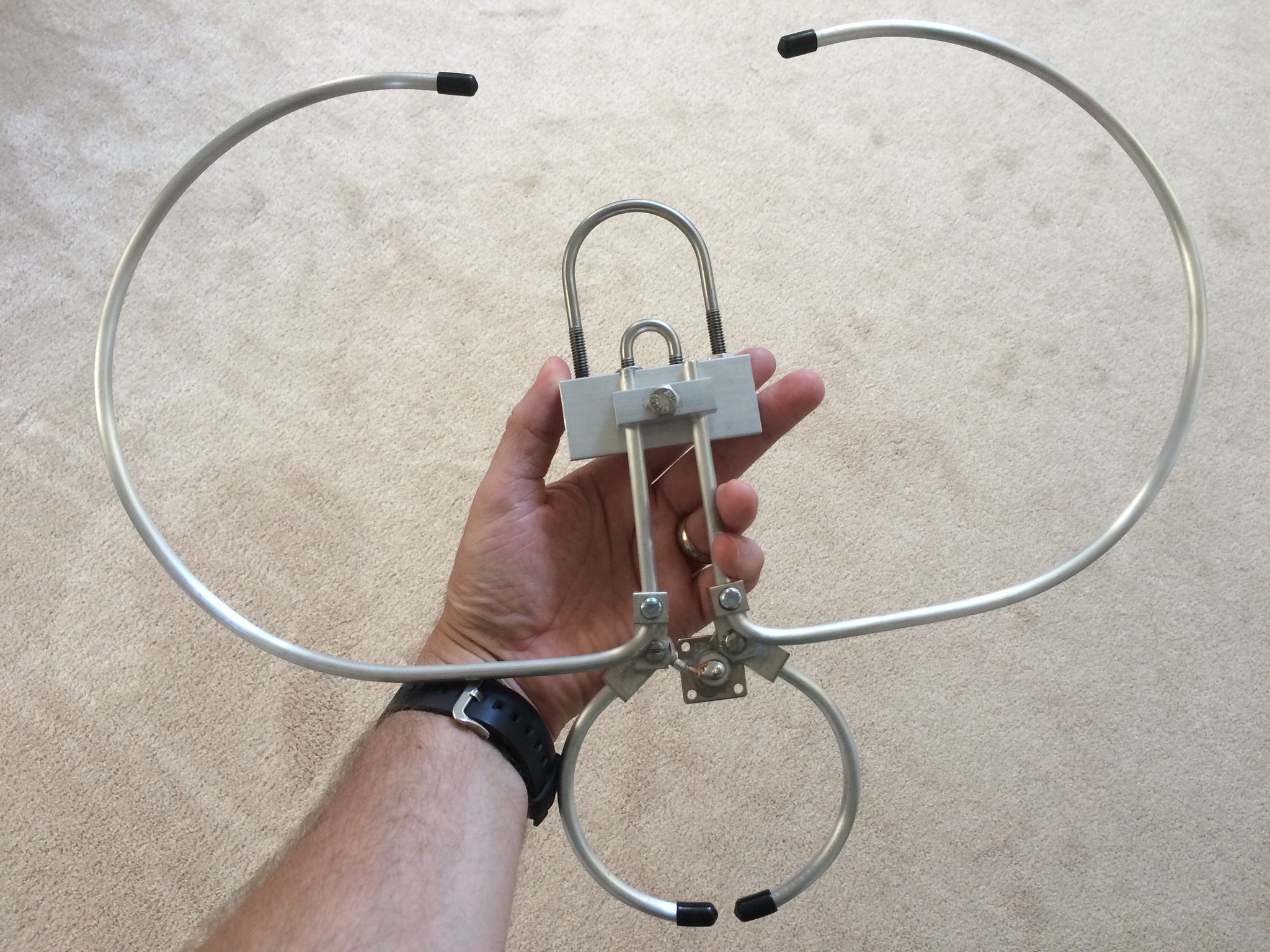
Efactor Dual-Band 144/432 MHz Antenna
I read a review of this antenna on Page 65 of the June 2017 issue of QST magazine and decided that I "needed" to have one. It is omnidirectional, horizontally-polarized, and intended for single-sideband (SSB), digital, or CW (Morse Code). Due to its light weight and compact size I intend to try it for 2-meter and 70-cm SSB during Summits on the Air (SOTA) activations.
It is made up of two dipoles in semi-circular configurations. The two U-bolts between my thumb and forefinger allow mounting to either of two sizes of antenna mast (one or the other is used at a time).
Tuesday, August 9, 2016
The First Antenna is Up
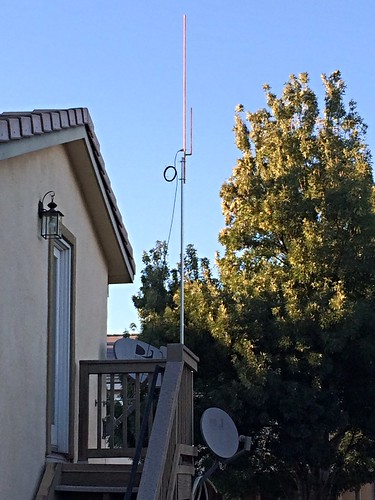
The mast--a 10-foot length of galvanized conduit--is mounted to the 4x4 railing corner post of the landing, which is just under 10 feet above the ground. I attached it with two large screw-type hose clamps, one at the top and one at the bottom of the post. It seems secure and has held up well, so far, in the winds that are common here. The cable runs through a window on the far side of the building; I used an MFJ window pass-through.
My ham shack is located on the upper floor of a detached garage to the rear of our house. My rig consists of a Yaesu FT-857D HF/6m/2m/70cm transceiver, along with an MF-4125 switching power supply and an LDG Z-11 Pro II antenna tuner. Photos of the inside of the shack to come soon (hopefully).
The antenna is a KB9VBR J-Pole, tuned for the 2-meter band (VHF); it also works well on the 70-cm band (UHF). I'm still researching HF antennas for those long-distance (DX) contacts.
The two satellite TV dishes are inactive.
Thursday, May 19, 2016
Activation Report: SOTA W6/NC-151
Today's activation of Mount Vaca was probably one of the easiest that I'll have in the course of my SOTA activities. I was able to drive to within 100 yards or so of my activation point on the summit. The road up Mix Canyon is very steep, winding, and narrow, but at least it's paved. There are multiple radio tower sites strung out along the ridge line, including several of the region's most popular ham radio repeaters. Fortunately, they didn't seem to interfere much with my operation.
One of my goals has been to log contacts on some of the bands that don't see much SOTA activity in this region, specifically 6 meters, 1.25 meters, and 70 centimeters (FM). I am happy to report that I logged contacts on each of these bands today. Granted, there was only one QSO per each band (and two of those were with the same chaser); it was quite satisfying to hear someone on the other end, though. Elliott, K6EL, in San Francisco, answered my call on 52.525 MHz (and also on 146.520, later). Dave, WB6DTB, in Oakley, was kind enough to follow me over from 446.000 to 223.500. Nine QSOs on 2 meters (146.520) made up the balance for a total of twelve.
I used my Yaesu VX-6R on 2 meters and 70 centimeters, a Wouxun KG-UV5D on 6 meters, and a TYT TH-UVF9 for my 1.25-meter contact. As an experiment, I tried my homebrew portable 2-meter antenna on 6 and 1.25 meters and it seemed to work well. I used a Maldol MH-510 whip for 70 cm.
The most distant contact was with Steve, KK6BNJ, approximately 70 miles to the southeast in Jenny Lind. I find this somewhat remarkable because I was situated just over the edge on the west side of the summit, with two very large (active) radio towers between us.


One of my goals has been to log contacts on some of the bands that don't see much SOTA activity in this region, specifically 6 meters, 1.25 meters, and 70 centimeters (FM). I am happy to report that I logged contacts on each of these bands today. Granted, there was only one QSO per each band (and two of those were with the same chaser); it was quite satisfying to hear someone on the other end, though. Elliott, K6EL, in San Francisco, answered my call on 52.525 MHz (and also on 146.520, later). Dave, WB6DTB, in Oakley, was kind enough to follow me over from 446.000 to 223.500. Nine QSOs on 2 meters (146.520) made up the balance for a total of twelve.
I used my Yaesu VX-6R on 2 meters and 70 centimeters, a Wouxun KG-UV5D on 6 meters, and a TYT TH-UVF9 for my 1.25-meter contact. As an experiment, I tried my homebrew portable 2-meter antenna on 6 and 1.25 meters and it seemed to work well. I used a Maldol MH-510 whip for 70 cm.
The most distant contact was with Steve, KK6BNJ, approximately 70 miles to the southeast in Jenny Lind. I find this somewhat remarkable because I was situated just over the edge on the west side of the summit, with two very large (active) radio towers between us.


Looking east, toward the Sacramento Valley

Looking west, with Lake Curry below

Far to the south, Mt. Diablo sticks out through the haze.

Looking north, with one of the numerous radio sites

Portable station KK6ZLX. The homebrew antenna gave a stellar performance.
SOTA Alert: W6/NC-151, Mount Vaca
19 May 2016, 1800 UTC (11:00 a.m. local time)
52.525 MHz, 146.520 MHz, 223.500 MHz, 446.000 MHz (all FM)
This should be a pretty straightforward activation. There is a decent road almost all the way up to the summit. Mt. Vaca is the high point of a major ridgeline on the eastern edge of the Coast Range, visible from a large swath of the Sacramento Valley.
This time around, I'm hoping to log at least one contact on 1.25 meters (223.500 MHz), as well as my first summit contact on 70 cm (446.000). More 6-meter contacts would be nice, too. 146.520 will be my fallback frequency in case the other bands don't pan out.
52.525 MHz, 146.520 MHz, 223.500 MHz, 446.000 MHz (all FM)
This should be a pretty straightforward activation. There is a decent road almost all the way up to the summit. Mt. Vaca is the high point of a major ridgeline on the eastern edge of the Coast Range, visible from a large swath of the Sacramento Valley.
This time around, I'm hoping to log at least one contact on 1.25 meters (223.500 MHz), as well as my first summit contact on 70 cm (446.000). More 6-meter contacts would be nice, too. 146.520 will be my fallback frequency in case the other bands don't pan out.
Friday, May 13, 2016
Activation Report: SOTA W6/NC-406
12 May 2016


My second attempt at this activation was a success. With the exception of a minor, last-minute antenna repair at home, there were no technical difficulties. Access to the summit was not a problem, either.
Sulphur Springs Mountain is 1,112 feet (339 meters) high; it is located on a ridge immediately east of the city of Vallejo, California. It is within the boundaries of what is known as the Hiddenbrooke Open Space. I hiked the Hiddenbrooke Trail, the trailhead of which is located along Hiddenbrooke Parkway, approximately 1/2-mile south of Interstate 80. A map from the Bay Area Ridge Trail Council indicates that there is parking at the intersection of McGary Road (parallel to I-80) and Hiddenbrooke Parkway; however, the small park-and-ride lot at that location was full. I was able to find a roadside parking space on the parkway, approximately 1/4-mile beyond the trailhead.
With the exception of two or three short steep sections, the trail was really not too difficult. The trail is easy to discern, with direction signs located at trail junctions.
From the top of the mountain, there are some great views of the north end of the San Francisco Bay and the cities of Vallejo and American Canyon to the north/northwest; to the south, Mt. Diablo (SOTA W6/CC-045) is quite prominent, along with the oil refineries in Benicia and Martinez. A couple of miles to the north can be seen Pt. 990 (W6/NC-422--formerly known as Pt. 970), a target of mine for the near future.
After a quick water break, I set up my 6-meter rig: a Wouxun KG-UV5D handheld (4 watts on 52.525 MHz) with a 45.5-inch base-loaded telescopic antenna. Within minutes, I was rewarded with my first-ever 6-meter FM contact: Jay, KE6GLA, in El Dorado Hills, 73.7 miles (118.61 km) away. Although it ended up being the only 6-meter contact that I logged on this day, I was pleased about it. I had no luck on 70 centimeters, one of my other goals for the day, though. I used my Yaesu VX-6R with a Maldol MH-510 20-inch whip for that attempt.
Next, I switched over to the old reliable: 2-meters (146.520 MHz). I connected my new homebrew portable 2-meter vertical antenna to my 5-watt Yaesu VX-6R and logged seven contacts in just over 30 minutes. Larry, KA6GND, was my most distant at 122.32 miles (196.8 km) away in Forest Ranch. My other six contacts ranged from 83.52 miles/134.41 km (Greg, KJ6KO, in Diamond Springs) down to 11.22 miles/18.05 km (Ron, KE6RS, in Pinole). Ron was one of two Bay Area contacts with whom I had virtual line-of-sight from my position.
Below are my call log and some photos.
With the exception of two or three short steep sections, the trail was really not too difficult. The trail is easy to discern, with direction signs located at trail junctions.
From the top of the mountain, there are some great views of the north end of the San Francisco Bay and the cities of Vallejo and American Canyon to the north/northwest; to the south, Mt. Diablo (SOTA W6/CC-045) is quite prominent, along with the oil refineries in Benicia and Martinez. A couple of miles to the north can be seen Pt. 990 (W6/NC-422--formerly known as Pt. 970), a target of mine for the near future.
After a quick water break, I set up my 6-meter rig: a Wouxun KG-UV5D handheld (4 watts on 52.525 MHz) with a 45.5-inch base-loaded telescopic antenna. Within minutes, I was rewarded with my first-ever 6-meter FM contact: Jay, KE6GLA, in El Dorado Hills, 73.7 miles (118.61 km) away. Although it ended up being the only 6-meter contact that I logged on this day, I was pleased about it. I had no luck on 70 centimeters, one of my other goals for the day, though. I used my Yaesu VX-6R with a Maldol MH-510 20-inch whip for that attempt.
Next, I switched over to the old reliable: 2-meters (146.520 MHz). I connected my new homebrew portable 2-meter vertical antenna to my 5-watt Yaesu VX-6R and logged seven contacts in just over 30 minutes. Larry, KA6GND, was my most distant at 122.32 miles (196.8 km) away in Forest Ranch. My other six contacts ranged from 83.52 miles/134.41 km (Greg, KJ6KO, in Diamond Springs) down to 11.22 miles/18.05 km (Ron, KE6RS, in Pinole). Ron was one of two Bay Area contacts with whom I had virtual line-of-sight from my position.
Below are my call log and some photos.


A view of Sulphur Springs Mountain from a point near the trailhead.

Another view of Sulphur Springs Mountain.

A view of the trail toward the summit, with one of the steeper sections ahead.

Looking south toward Mt. Diablo (W6/CC-045), with Suisun Bay and the refineries at Benicia and Martinez.
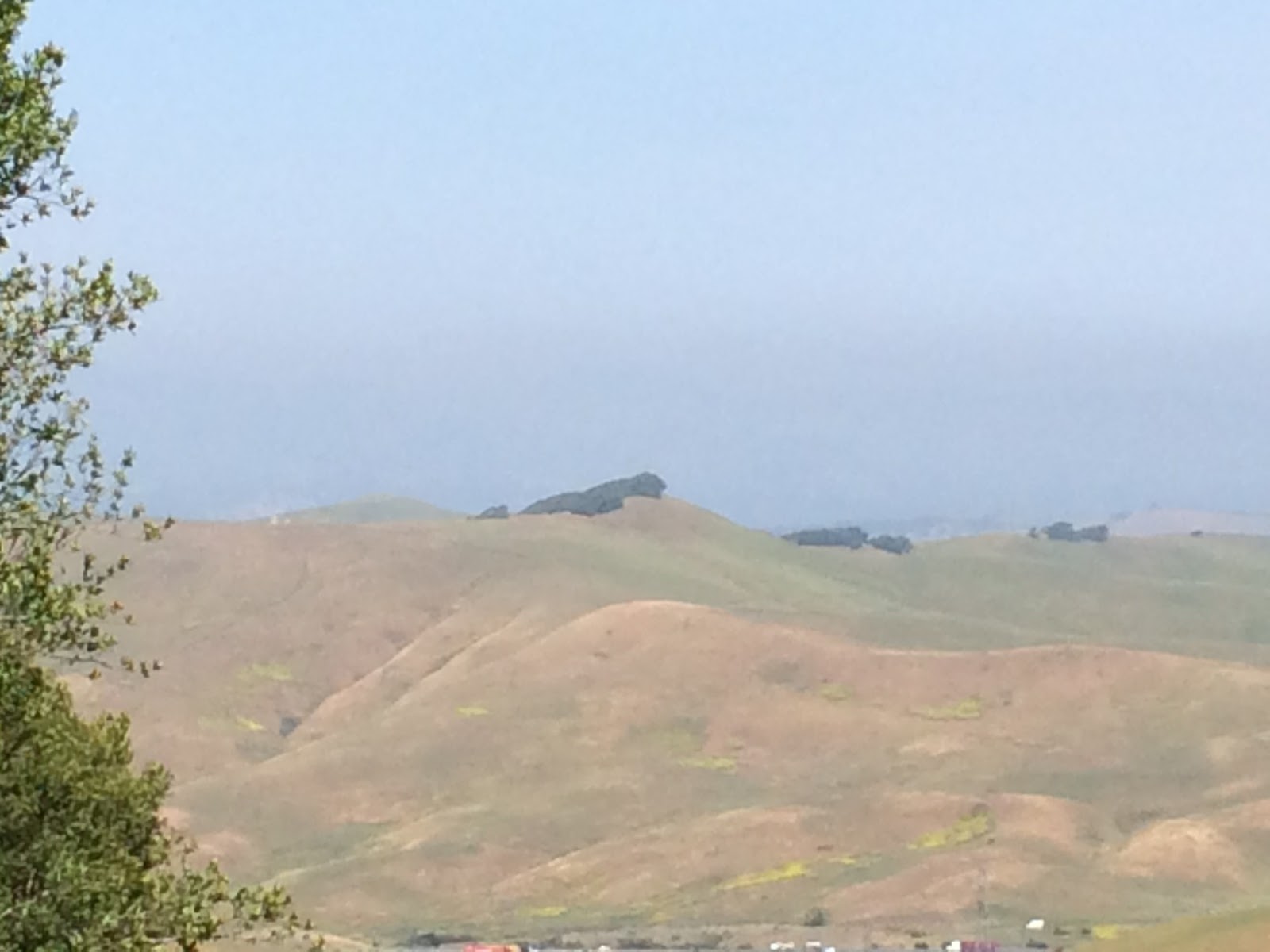
Pt. 990 (W6/NC-422), a couple of miles to the north.

The Hiddenbrook Subdivision, below to the east.

Portable station KK6ZLX, with my Wouxun KG-UV5D connected to my homebrew antenna. As you can see from the angle of the grass, it was quite windy.
Monday, May 9, 2016
SOTA Alert: Sulphur Springs Mountain, W6/NC-406
Thursday 12 May 2016, 18:00 UTC (11:00 a.m. local time)
52.525 MHz, 446.000 MHz, 146.520 MHz (all FM)
This will be my second attempt at activating this summit. The first time, a lack of proper research led me down the wrong path--literally. Now that I am more confident of the proper route, I'm going to give it another shot.
I would really like to make some FM contacts on 6 meters and 70 centimeters this time (52.525 and 446.000 MHz, respectively), just because it happens so rarely and to show it's possible.
Sulphur Springs Mountain is located in southwestern Solano County, above the city of Vallejo, California.
52.525 MHz, 446.000 MHz, 146.520 MHz (all FM)
This will be my second attempt at activating this summit. The first time, a lack of proper research led me down the wrong path--literally. Now that I am more confident of the proper route, I'm going to give it another shot.
I would really like to make some FM contacts on 6 meters and 70 centimeters this time (52.525 and 446.000 MHz, respectively), just because it happens so rarely and to show it's possible.
Sulphur Springs Mountain is located in southwestern Solano County, above the city of Vallejo, California.
Monday, April 25, 2016
SOTA Alert: Pt. 970, W6/NC-422
Thursday 28 April 2016, 20:00 UTC (1:00 p.m. local time)
52.525 MHz-FM, 146.520 MHz-FM, 446.000 MHz-FM
This will be my second Summits-on-the-Air activation. This time, I'm planning to attempt contacts on 6 meters, 70 cm, and 2 meters, in that order. This will be an opportunity for the first real field test of my new homebrew portable 2-meter antenna.
52.525 MHz-FM, 146.520 MHz-FM, 446.000 MHz-FM
This will be my second Summits-on-the-Air activation. This time, I'm planning to attempt contacts on 6 meters, 70 cm, and 2 meters, in that order. This will be an opportunity for the first real field test of my new homebrew portable 2-meter antenna.
Tuesday, February 23, 2016
I'm surely not the only one...
...who likes looking at pictures of radios.
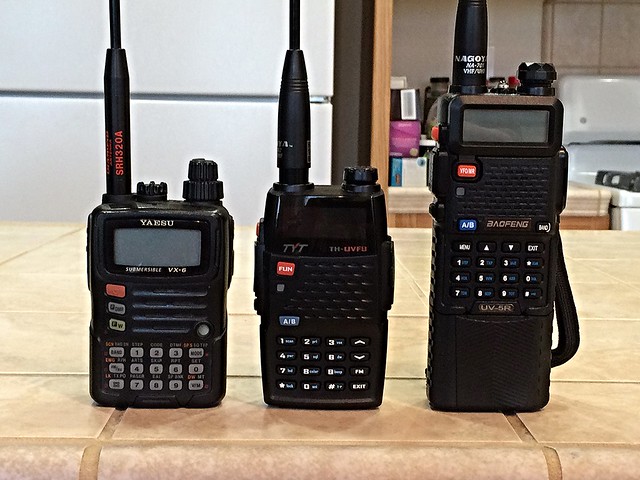
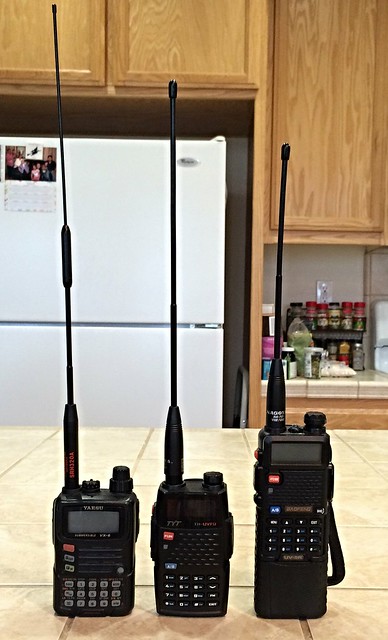
Left to right in both pictures:
- Yaesu VX-6R (144/220/440 MHz) with a Diamond SRH320A tri-band antenna
- TYT TH-UVF9 (144/220 MHz) with a Nagoya NA-702 VHF/UHF antenna
- Baofeng UV-5R (144/440 MHz) with a Nagoya NA-701 VHF/UHF antenna and high-capacity 3800-mAh battery
Radio #3: Yaesu VX-6R
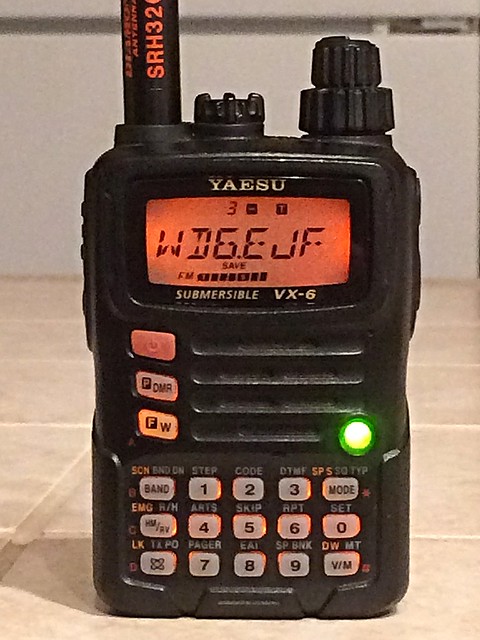
After juggling the UV-5R and TH-UVF9 for a few weeks, I became aware of the VX-6R. It is a "tri-bander," programmed for 2 meters, 1.25 meters, and 70 cm. It became readily apparent that it would be much more convenient to carry one radio, under normal circumstances, than two (as mentioned previously, I had bought the other two radios so that I could have access to the three bands). I got hold of a nice secondhand VX-6R for a very reasonable price on eBay. It is very rugged (and submersible). It is also very small, which is not obvious from the photo.
I use a Diamond SRH320A tri-band antenna with this radio.
For the time being, I am keeping the other two radios as backups. I may soon sell them, though, to offset the cost of another radio I'm considering--a Wouxun KG-UV5D which is programmed for the 6-meter band (50 MHz), in addition to 2 meters. With that purchase, I would have the capability to operate on four bands with only two handheld radios.
I'll start thinking about base and/or mobile radios after I get my General Class license.
Radio #1: Baofeng UV-5R
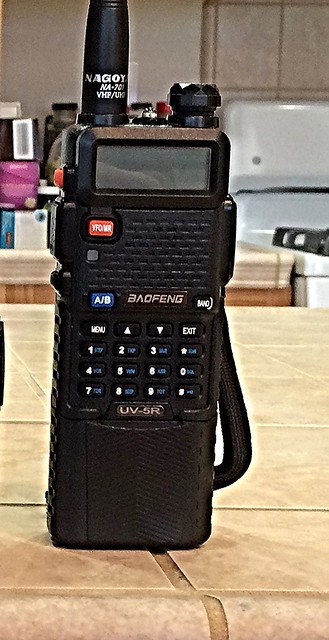
This was my first handheld transceiver. I won it on eBay for $32. After realizing that I needed an FCC license to be able to anything more than just listen to it, I finally had the motivation I needed to go out and get my Technician Class ticket (discovering that the Morse Code requirement was gone helped, too).
The radio is programmed for the 2-meter and 70-centimeter bands. Optional accessories seen in the photo include an authentic Nagoya NA-701 VHF/UHF antenna (tuned for 144/440 MHz) and a larger, 3800 mAh extended life battery.
I have heard and read many disparaging remarks about this and other low-price Chinese radios. I really have no complaints, though, especially considering the price. It seems to perform well, so far.
Subscribe to:
Posts (Atom)