Showing posts with label uhf. Show all posts

Sunday, July 9, 2017

My Latest Radio Acquisition

Several months ago, I purchased a used Yaesu FT-897 transceiver for use in the shack. I was initially using the FT-857D for both base and portable operations, but I decided that it would be much simpler to have one radio for each purpose rather than to switch the 857 back and forth between the two.

This is appears to be an earlier-model FT-897, as opposed the later FT-897D, although it can be difficult to tell between the two--the labeling on both versions is identical. From online research, I was able to determine that the 897D has the five 60-meter channels already programmed into its memory, while the 897 does not; mine does not have it, so it seems to be the earlier version. My initial confusion stemmed from the fact that the radio I bought was advertised as a "D" version; the radio works fine and meets my needs, though, so I consider this to be a non-issue.

Functionally, the FT-897 is essentially the same radio as the 857 in a slightly larger package. The menu items are all the same; the toughest part for me was getting used to the arrangement of the knobs and buttons, which is different than on the 857.

I also bought an LDG AT-897 Plus antenna tuner, which mounts on the side of the radio (as seen in the photo below).

Here's a view of the radio shack, with the FT-897 in the space formerly occupied by the FT-857D. Note the AT-897 Plus tuner mounted on the side of the radio.

Tuesday, August 9, 2016

The First Antenna is Up

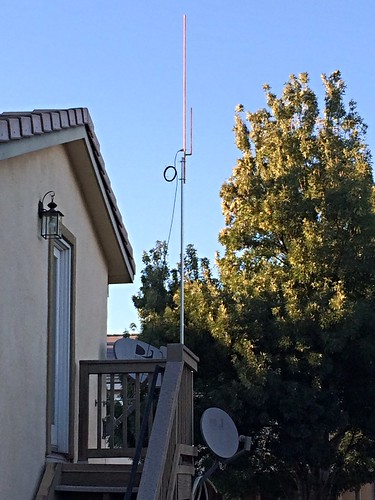
Station W6SAE: 2-Meter J-Pole Antenna
The mast--a 10-foot length of galvanized conduit--is mounted to the 4x4 railing corner post of the landing, which is just under 10 feet above the ground. I attached it with two large screw-type hose clamps, one at the top and one at the bottom of the post. It seems secure and has held up well, so far, in the winds that are common here. The cable runs through a window on the far side of the building; I used an MFJ window pass-through.

My ham shack is located on the upper floor of a detached garage to the rear of our house. My rig consists of a Yaesu FT-857D HF/6m/2m/70cm transceiver, along with an MF-4125 switching power supply and an LDG Z-11 Pro II antenna tuner. Photos of the inside of the shack to come soon (hopefully).

The antenna is a KB9VBR J-Pole, tuned for the 2-meter band (VHF); it also works well on the 70-cm band (UHF). I'm still researching HF antennas for those long-distance (DX) contacts.

The two satellite TV dishes are inactive.

Thursday, June 9, 2016

New Rig

In anticipation of my passing the General Class examination this Saturday and gaining new frequency privileges, I have purchased a Yaesu FT-857D. I was the winning bidder for a like-new example on eBay. The FT-857D is a very compact HF/VHF/UHF mobile transceiver suitable for base station, mobile, or portable work. This particular model was a fairly easy choice because of it's suitability for SOTA, as well as the almost universal praise for it that I have read online.

It is still shipping but I am anxiously awaiting its arrival. I anticipate using it mostly for single sideband (ssb) operation during SOTA activations.

Tuesday, February 23, 2016

I'm surely not the only one...

...who likes looking at pictures of radios.
Handheld Transceivers
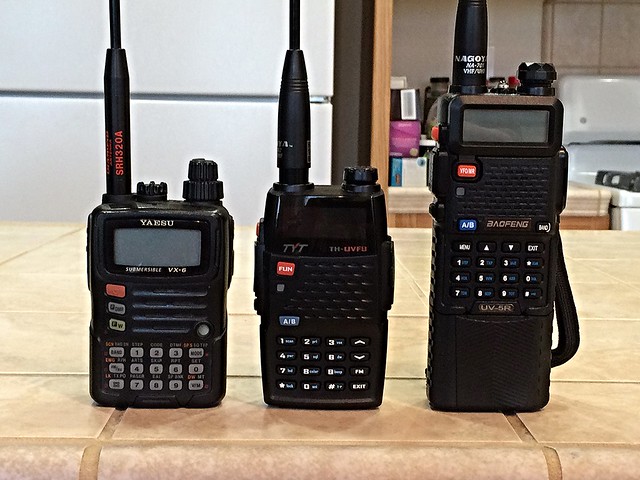
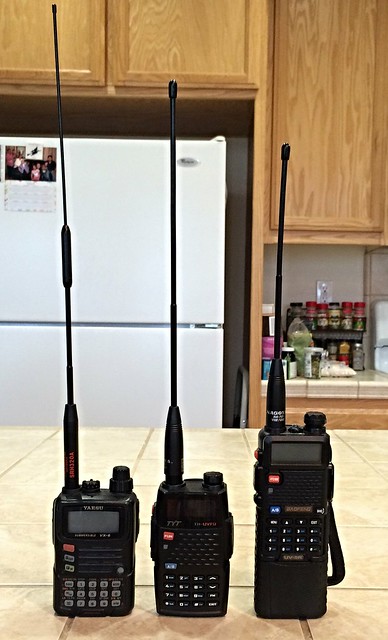
Left to right in both pictures:
  • Yaesu VX-6R (144/220/440 MHz) with a Diamond SRH320A tri-band antenna
  • TYT TH-UVF9 (144/220 MHz) with a Nagoya NA-702 VHF/UHF antenna
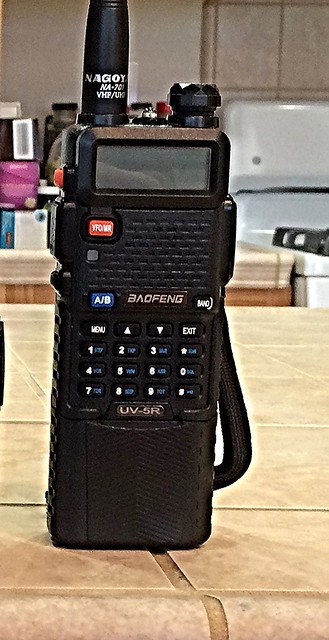
  • Baofeng UV-5R (144/440 MHz) with a Nagoya NA-701 VHF/UHF antenna and high-capacity 3800-mAh battery

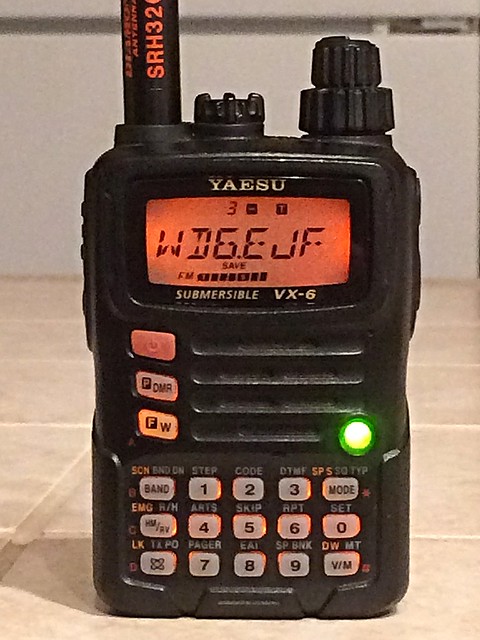
Radio #3: Yaesu VX-6R

Yaesu VX-6R

After juggling the UV-5R and TH-UVF9 for a few weeks, I became aware of the VX-6R. It is a "tri-bander," programmed for 2 meters, 1.25 meters, and 70 cm. It became readily apparent that it would be much more convenient to carry one radio, under normal circumstances, than two (as mentioned previously, I had bought the other two radios so that I could have access to the three bands). I got hold of a nice secondhand VX-6R for a very reasonable price on eBay. It is very rugged (and submersible). It is also very small, which is not obvious from the photo.

I use a Diamond SRH320A tri-band antenna with this radio.

For the time being, I am keeping the other two radios as backups. I may soon sell them, though, to offset the cost of another radio I'm considering--a Wouxun KG-UV5D which is programmed for the 6-meter band (50 MHz), in addition to 2 meters. With that purchase, I would have the capability to operate on four bands with only two handheld radios.

I'll start thinking about base and/or mobile radios after I get my General Class license.

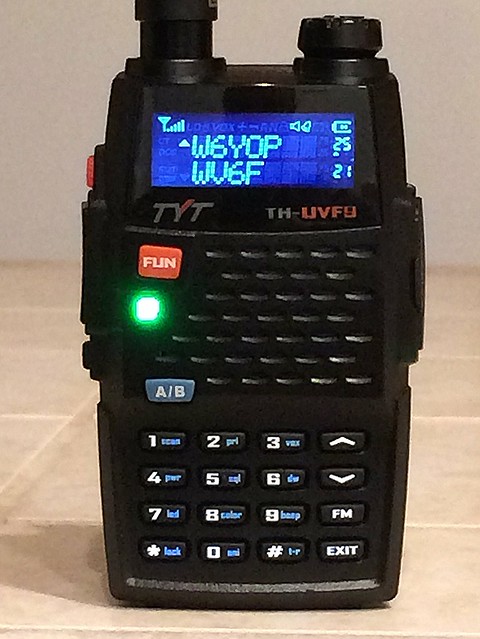
Radio #2: TYT TH-UVF9

TYT TH-UVF9

This radio was also an eBay acquisition. It cost approximately twice as much as the UV-5R. I bought it because I wanted access to the 1.25-meter (220 MHz) band; it's programmed for 2-meters, as well. The photo is somewhat misleading as to the size of the radio--it's actually quite small.

1.25-meter activity is pretty sparse here in my part of Northern California but I like having the capability of operating on the band.

The antenna is a Nagoya NA-702, tuned for 144 and 220 MHz.

Radio #1: Baofeng UV-5R

Baofeng UV-5R

This was my first handheld transceiver. I won it on eBay for $32. After realizing that I needed an FCC license to be able to anything more than just listen to it, I finally had the motivation I needed to go out and get my Technician Class ticket (discovering that the Morse Code requirement was gone helped, too).

The radio is programmed for the 2-meter and 70-centimeter bands. Optional accessories seen in the photo include an authentic Nagoya NA-701 VHF/UHF antenna (tuned for 144/440 MHz) and a larger, 3800 mAh extended life battery.

I have heard and read many disparaging remarks about this and other low-price Chinese radios. I really have no complaints, though, especially considering the price. It seems to perform well, so far.

Saturday, February 20, 2016

The Baofeng UV-5R Demystified

Anyone who finds manually programming the UV-5R daunting should find this blog post by WP4AOH useful. He also goes through the various menu settings that are appropriate for amateur radio use.