Sunday, July 9, 2017

My Latest Radio Acquisition

Several months ago, I purchased a used Yaesu FT-897 transceiver for use in the shack. I was initially using the FT-857D for both base and portable operations, but I decided that it would be much simpler to have one radio for each purpose rather than to switch the 857 back and forth between the two.

This is appears to be an earlier-model FT-897, as opposed the later FT-897D, although it can be difficult to tell between the two--the labeling on both versions is identical. From online research, I was able to determine that the 897D has the five 60-meter channels already programmed into its memory, while the 897 does not; mine does not have it, so it seems to be the earlier version. My initial confusion stemmed from the fact that the radio I bought was advertised as a "D" version; the radio works fine and meets my needs, though, so I consider this to be a non-issue.

Functionally, the FT-897 is essentially the same radio as the 857 in a slightly larger package. The menu items are all the same; the toughest part for me was getting used to the arrangement of the knobs and buttons, which is different than on the 857.

I also bought an LDG AT-897 Plus antenna tuner, which mounts on the side of the radio (as seen in the photo below).

Here's a view of the radio shack, with the FT-897 in the space formerly occupied by the FT-857D. Note the AT-897 Plus tuner mounted on the side of the radio.

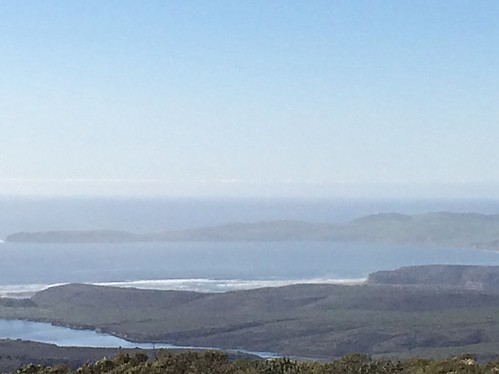
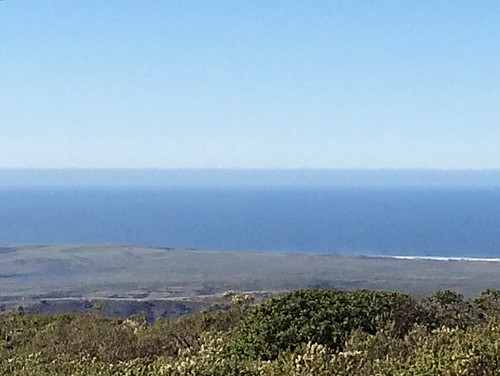
The View from Goat Mountain...

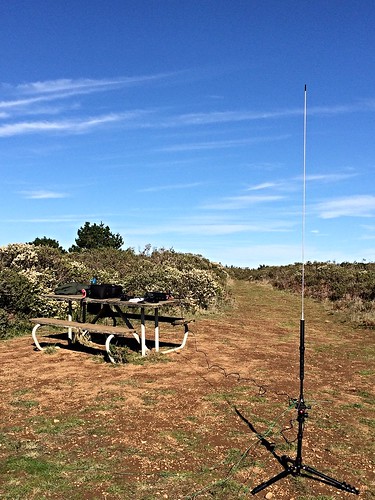
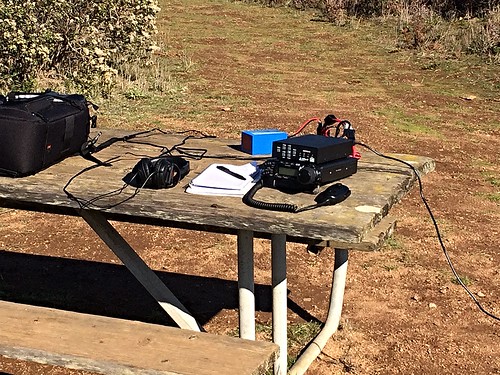
...or, at least a view of my portable station on Goat Mountain (SOTA W6/NC-010).

My standard HF rig for portable operation is my trusty Yaesu FT-857D, running through an LDG Z-11 Pro II automatic antenna tuner to a Yaesu ATAS-25 vertical antenna (seen elsewhere in this blog). I usually operate at 50 watts power, although lately I have occasionally upped it to 75 or even 100 watts due to difficult band conditions. For power, I use a Bioenno BLF-1206A Lithium Iron Phosphate (LiFePO4) 12V 6Ah battery. The ATAS-25 is tuned for bands from 40 meters up to 70 cm, although I generally use my Yaesu VX-6R handheld and a homebrew vertical for VHF and up.

Catching Up (Again): SOTA Activations

First of all, I would like to apologize to anyone who has been following this blog; I have not been keeping it up-to-date. I have been pretty active, especially in regards to Summits on the Air (SOTA) activity, but I have not been as motivated to maintain the blog as I should be.

I have activated 16 summits since my last activation report (Mt. Tamalpais, W6/CC-063) on December 17, 2016. So far, they have all been in Northern California:

  • 29 December 2016: W6/CC-051 (North Peak), 2 points -- Highlights: QSO with AC1Z in New Hampshire on 20 meters (14 MHz), plus three summit-to-summit (S2S) contacts and two National Parks on the Air (NPOTA) contacts. I was operating with 50 watts, single-sideband (SSB).
  • 15 January 2017: W6/CV-017 (968), 1 point -- Highlight: N4DA, near Atlanta, Georgia, on 20 meters SSB.
  • 31 January 2017: W6/NC-406 (Sulphur Springs Mountain), 0 points -- I only logged three contacts on 40 meters SSB, and did not qualify (a minimum of four is required). Conditions were tough on this day.
  • 14 March 2017: W6/CC-049 (Cold Spring Mountain), 2 points -- I logged my first contacts on 15 meters (21 MHz) SSB: K3TCU in Pennsylvania, and W9MRH and WA2USA in Indiana.
  • 30 March 2017: W6/NC-151 (Mount Vaca), 2 points -- My longest-distance QSO was with WA2USA in Indiana on 14 MHz SSB.
  • 2 April 2017: W6/NC-422 (990), 1 point -- I initially tried taking part in the AM Rally but was hampered in part by a solar flare. I was able to log some good QSOs on 20 meters SSB, including two each in Minnesota, Kansas, and Montana. Also, an S2S with W6CLB, who was doing his first SOTA activation nearby.
  • 22 April 2017: W6/NC-432 (Chabot 2 Benchmark), 1 point -- Conditions were badly deteriorated on this day, but I was able to log the minimum four contacts over a two-hour period. On a positive note, I was able to log two S2S contacts, with AC2KL in Utah and NS7P in Oregon on 40 meters (7 MHz) SSB.
  • 2 May 2017: W6/NC-298 (Vollmer Peak), 1 point -- Once again, difficult conditions but I was able to log the four QSOs needed to qualify. 
  • 2 May 2017: W6/CC-045 (Mount Diablo), 2 points -- Most contacts logged were on 2 meters (146.520 MHz FM), but I did log three contacts on 20 meters SSB with Arizona and New Mexico.
  • 11 May 2017: W6/NC-010 (Goat Mountain), 6 points -- Three of my five contacts were on 17 meters (18 MHz) SSB.
  • 23 May 2017: W6/NC-379 (Taylor Mountain), 0 points -- I was only able to eke out two contacts: W0MNA in Kansas, barely readable on 20 meters SSB, and K6EL, loud and clear from San Francisco on 15 meters SSB. I left my 2-meter handheld radio in the car; otherwise I might have been able to round out my contacts on 146.520 FM and have qualified.
  • 4 June 2017: W6/NC-417 (Abrott Benchmark), 1 point -- As has become common for me, I was just able to log the minimum four QSOs need to qualify: two each on 40 and 20 meters SSB.
  • 15 June 2017: W6/NS-290 (Big Hill), 6 points -- My first Sierra Nevada activation of the year, this summit features very easy access and spectacular views. I logged 8 contacts on 40, 20, and 17 meters (SSB) and 2 meters FM.
  • 27 June 2017: W6/NS-248 (7008), 6 points -- Hill 7008 is located at South Lake Tahoe, California, literally across the street from the airport. Four QSOs on 40 and 20 meters SSB with Oregon, Arizona, and Texas.
  • 28 June 2017: W6/NS-397 (Tahoe Mountain), 6 points -- Virtually a stone's-throw away from the previous summit; once again four contacts to qualify (20 meters SSB), plus one local on 146.520 FM with WA6EWV for good measure.
  • 1 July 2017: W6/SN-039 (Leviathan Peak), 8 points -- I stopped here on my way home from South Lake Tahoe. The spectacular views of the Sierra Nevada mountains and the state of Nevada made it totally worth the mere four contacts that I logged. A highlight was an S2S with AE7AP in Montana.

Saturday, December 17, 2016

Activation Report: SOTA W6/CC-063

Today I went to the summit of Mount Tamalpais, in Marin County across the Golden Gate from San Francisco, intending to attempt a "summit-to-summit" contact with my friend Andrew, VK1AD, who was activating Mount Stromlo (VK1/AC-043) in the Australian Capital Territory. Much to my chagrin, I left my freshly-charged 12-volt battery sitting on the kitchen counter at home and was unable to work any HF. It was also a little embarrassing, as a father and his two young sons were watching me set up my rig in hopes of seeing me operate my radio. It was a little awkward for all of us when I realized what I had done.

I had brought a handheld FM radio (a Yaesu VX-6R), however, and was at least able to log 9 contacts on the 2-meter band (146.520 MHz FM) and qualify for an activation of the summit.


Looking South from Mt. Tamalpais
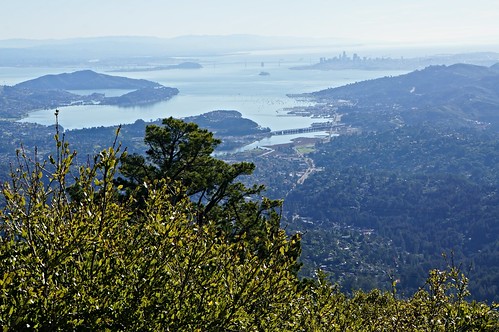
Looking south, with San Francisco in the distance.

Looking South-Southwest from Mt. Tamalpais
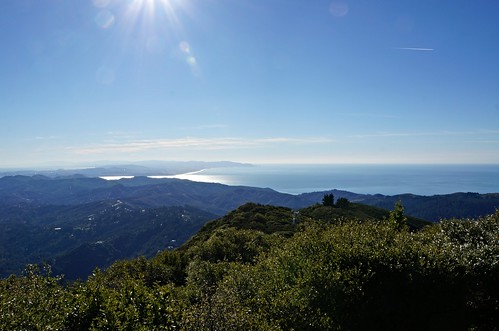
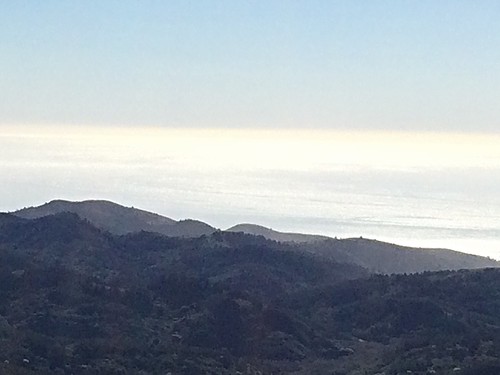
The Pacific Ocean, over which I had hoped to talk to VK1AD.

Mt. Tamalpais
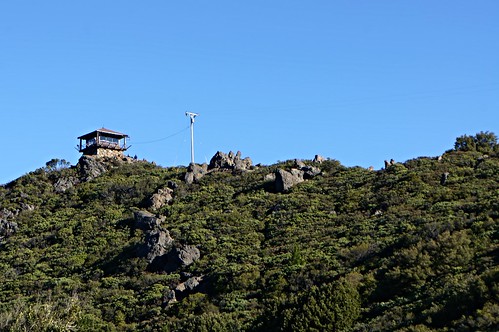
The summit of the east peak of Mt. Tamalpais, as seen from below.

Thursday, December 1, 2016

Portable/Mobile on Mt. Vaca

Today I drove up to near the summit of Mount Vaca (SOTA W6/NC-151), put my Yaesu ATAS-25 antenna on the roof of my car, and "tuned the bands" to see what I would come up with. I didn't operate as a Summits-On-The-Air activation; I was operating from my vehicle--a SOTA no-no, plus I already activated the summit this year.

I logged four contacts:
  • On 20 meters (14.340 MHz), I chased KD0YOB, who was activating Iron Mountain (SOTA summit W0C/MZ-031) in northern Colorado, gaining four chaser points for myself. The distance was approximately 822 miles (1323 km).
  • On 14.275 MHz, I chased N4CD, who was conducting a National Parks on the Air (NPOTA) activation at Carlsbad Caverns National Park (NP10) for a distance of approximately 1,079 miles (1736 km).
  • On 17 meters (18.125 MHz), I responded to a CQ from Norm, NH6I, on the "Big Island" of Hawaii (approximately 2,419 miles [3893 km] away). This is my longest-distance contact thus far.
  • On 40 meters (7.230 MHz) I logged another NPOTA contact, this time with K6WDE, who was operating from the Mojave National Preserve (PV13) in the Southern California desert, a little over 400 miles (644 km) away.
On the first three contacts, I needed to run 75 watts to be heard; 50 watts was sufficient for the last one.


Mobile/Portable
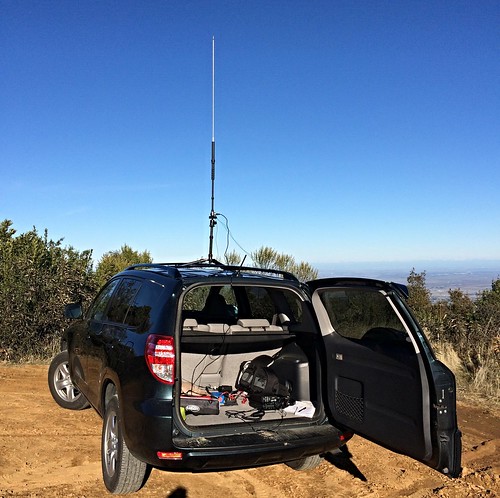
My trusty Yaesu FT-857D is ready for action in the back of my RAV4.

Untitled
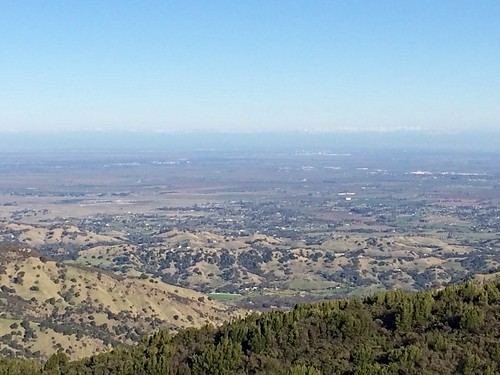
Looking east, with Sacramento and the Sierra Nevada mountains in the distance.

Untitled
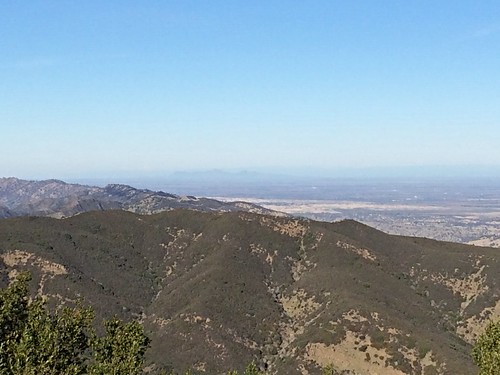
Looking northeast; in the distance, the Sutter Buttes can be seen rising from the floor of the Sacramento Valley.

Untitled
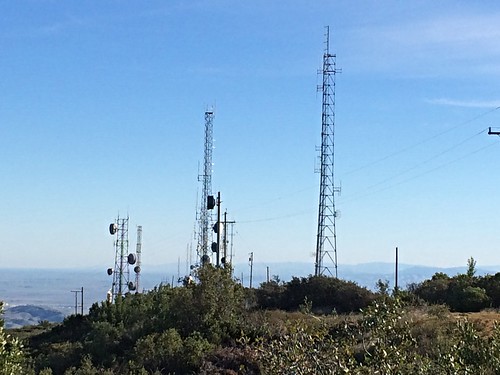
These are just a few of the many radio towers that line Blue Ridge.

Untitled
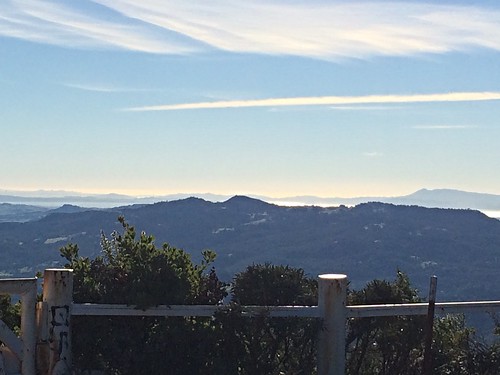
Looking west toward San Francisco Bay, with Mt. Tamalpais in the distance at right center.

Activation Report: SOTA W6/CC-071

On Tuesday, November 29, I activated Point Reyes Hill (elevation 1336 feet [407 meters]), which is located within the boundaries of the Point Reyes National Seashore. Access is quite easy, with a short .4-mile walk from the gate at the end of the road near the top of the hill.

While driving the road up the hill, I encountered another ham. Fred, N6YEU, was activating Point Reyes for National Parks On The Air (NPOTA). He was operating from the camper on the back of his pickup truck; the large inverted-v dipole antenna projecting above the truck is what caught my eye and identified him as a ham. After chatting with Fred for a few minutes, I continued a short distance up the road to the parking area near the gate.

The activation area at the top of the hill has spectacular views of the seashore and the Pacific Ocean. There is also, quite conveniently for a radio operator, a picnic table. The sky was crystal clear, with a few light clouds overhead and some fog over the ocean in the distance. There was just light breeze; it was hard to believe that it had been rainy and stormy for the several days prior.

I set up my rig and started calling "CQ" on the 20-meter band (14.310 MHz). It took a little time before I logged my first contact, NQ7R in Arizona. Two minutes later, I heard from the aforementioned Fred, N6YEU, who was just down the hill from me. He also responded 35 minutes later, after I rolled over to 7.239 MHz (40 meters). I logged a total of eight contacts over a period of just over two hours, including another Arizona station, two from New Mexico, and one from Southern California. A highlight was a Summit-to-Summit with K6YOA/P on Ryan Mountain Mountain (W6/CD-016) in the Joshua Tree National Monument, also another NPOTA contact.


W6SAE, SOTA W6/CC-071
A perfect spot for a hilltop radio station. The antenna is a Yaesu ATAS-25.

W6SAE, SOTA W6/CC-071
Portable radio station W6SAE: Yaesu FT-857D transceiver, LDG Z-11 Pro II antenna tuner, LiFePo4 battery, and MFJ headphones.

W6SAE, SOTA W6/CC-071